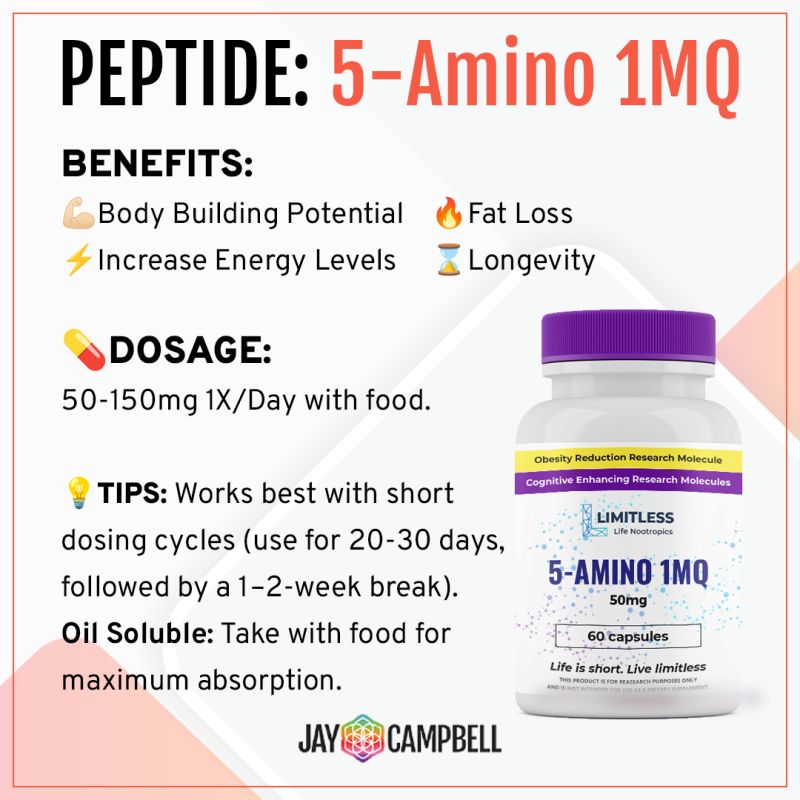
Researchers commonly utilize 5-Amino-1MQ in biochemical and in-vitro model systems to investigate metabolic pathway regulation, enzyme inhibition dynamics, and cellular signaling processes related to energy homeostasis and methylation control
Cycle length 8 weeks Where it comes from Community research planning How to label it Anecdotal Cycle length 12 weeks Where it comes from Published trial duration and community planning How to label it Published and community context Cycle length 16 weeks Where it comes from Community research planning How to label it Anecdotal Cycle length 24 weeks Where it comes from Published trial duration How to label it Published research Read the full AOD-9604 cycle-length guide for a closer look at 8-, 12-, 16-, and 24-week timelines
Timing Optional Monitoring guidance is pathway-based because compound-specific clinical monitoring standards for AOD-9604 are not established
What a Meaningful Certificate of Analysis Should Include Complete chemical name Declared salt and counterion Free-cation and salt molecular weights where relevant Batch number and manufacture date Observed LC-MS result NMR identity evidence Counterion result Quantitative active-content assay Chromatographic purity Named and unknown impurity results Residual-solvent results Water or loss-on-drying result Elemental or inorganic-impurity testing where appropriate Method references and acceptance limits Testing-laboratory identity A clear statement of tests not performed Why 99% Purity Is Not Enough A single chromatographic percentage does not prove that the main peak is the correct positional isomer, that the counterion is correct, that the quantity is calculated properly or that residual solvents and inorganic impurities meet an appropriate specification
Important: 5-Amino-1MQ is a research compound and is not FDA-approved to treat any condition